Friday, March 20th, 2026
Dearly Beloved Brothers and Sisters in Christ,
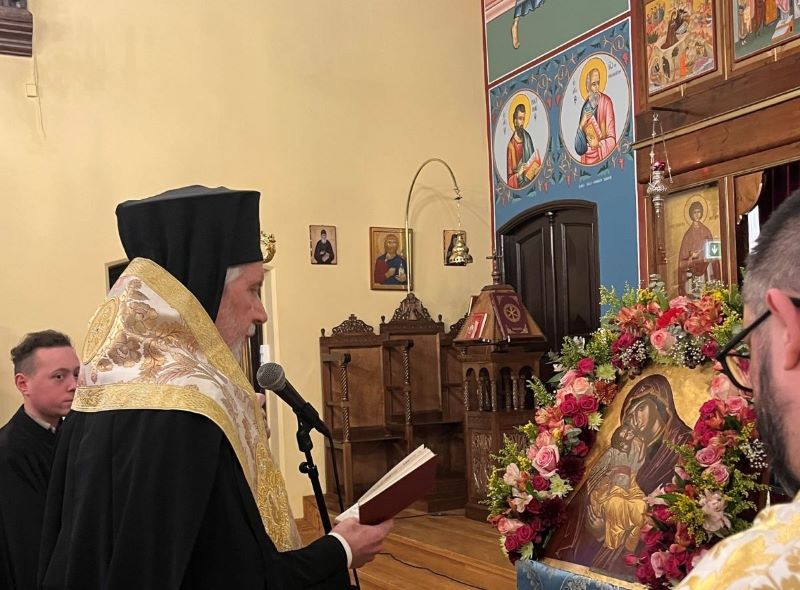
In the fourth stanza of the Akathist Hymn we hear the words describing Joseph, troubled in mind when he saw the Virgin with child. He knew her purity, yet he struggled to comprehend the mystery unfolding before him.
The hymn places us within that moment of trembling wonder when human understanding confronts the divine mystery of the Incarnation.
The Church sings: “Within his mind the chaste Joseph was troubled… yet learning that your conception was of the Holy Spirit, he cried: Alleluia.”

This scene reveals a profound spiritual truth: God’s saving work often first appears as confusion to the human mind. The mystery of Christ cannot be grasped merely through reasoning. It must be received through faith and illumination by the Holy Spirit.
St. Gregory the Theologian teaches that the Incarnation is the “supreme paradox”; the Infinite becomes an infant, the Creator enters creation. Joseph’s bewilderment therefore mirrors the astonishment of all humanity before this mystery.
Likewise, St. John of Damascus reminds us that the Virgin’s conception was not simply miraculous but ontological; God Himself assumed human nature. Joseph’s struggle represents the limits of natural understanding before divine revelation.
The hymn does not condemn Joseph’s confusion; rather it sanctifies it. The Church shows that honest perplexity can become the doorway to faith when the heart remains righteous.
Joseph’s turmoil arises precisely because he knows the Virgin’s holiness. The Church calls her Panagia; the All-Holy one.
St. Gregory Palamas writes that the Theotokos was uniquely prepared to receive the Incarnate Word because she possessed perfect synergy with divine grace. Her purity was not merely physical but spiritual; an inner temple for the living God.
The Akathist therefore celebrates her as the one through whom the impossible becomes possible.
The hymn proclaims that Joseph eventually recognizes the divine action and responds, not with argument, but with worship, Alleluia.
St. Maximus the Confessor teaches that human reason must be transfigured by divine illumination. Knowledge of God arises, not from intellectual mastery, but from participation in grace.
Joseph’s journey in this stanza is precisely such a transformation. His mind moves from suspicion to wonder, to revelation, to praise. This is the path of every believer who encounters Christ.
Fr. Alexander Schmemann emphasizes that the Theotokos represents the perfect human response to God’s initiative. In her, humanity says “yes” to divine love.
Similarly, Fr. John Meyendorff explains that Marian theology in Orthodoxy is inseparable from Christology; we honor Mary because through her the Word truly became flesh.
The fourth stanza speaks, not only of Joseph, but of every Christian heart. Often we too stand before circumstances that seem confusing or even troubling. We cannot see how God is working. Yet the Akathist teaches us that divine grace often acts quietly and mysteriously within our lives, just as it did in the womb of the Virgin.
When we remain faithful, like Joseph, confusion becomes revelation, and when revelation comes, the only fitting response is the same word sung in the hymn: Alleluia; Glory to God. Amen!

Με ιδιαίτερη χαρά και συγκίνηση σας καλωσορίζουμε σήμερα στον Μητροπολιτικό Ναό του Ευαγγελισμού της Θεοτόκου Όσλο, με την ευκαιρία της προσευχητικής συμμετοχής σας και της συνοδείας σας στην Δ´ Στάση των Χαιρετισμών προς την Κυρία Θεοτόκο.
Η παρουσία σας αποτελεί τιμή για την τοπική μας Εκκλησία και την Ομογένειά μας καθόλη.
Ιδιαιτέρως δε, η Ποντιακή σας καταγωγή συγκινεί και εμπνέει τους πολυάριθμους Ποντίους αδελφούς μας, σε ολόκληρη την Σκανδιναυΐα, οι οποίοι διατηρούν ζωντανή την ιστορία, την πίστη και την παράδοσή τους.
Ως ελάχιστο δείγμα τιμής και αγάπης, επιτρέψτε μου, να σας προσφέρω ένα βιβλίο αφιερωμένο στην Παναγία Σουμελά, το οποίο αποτελεί πολύτιμο πνευματικό κειμήλιο, μιας και μου προσεφέρθη από την Α. Θ. Παναγιότητα, τον Οικουμενικό Πατριάρχη κ.κ. Βαρθολομαίο, καθώς κι έναν μικρό επιστήθιο σταυρό, ως ευλογία και ενθύμιο της σημερινής σας παρουσίας.
Με την ευκαιρία αυτή, σας εκφράζουμε από καρδιάς τα θερμά μας συγχαρητήρια για την μέχρι τούδε πορεία σας και σας ευχόμαστε καλή επιτυχία στον επικείμενο Α´ Ημιτελικό της Eurovision.
Είθε ο Θεός να ευλογεί τα έργα σας, να σας χαρίζει δύναμη και φωτισμό, και να σας αξιώνει να προβάλλετε πάντοτε με υπερηφάνεια την καταγωγή και την ιστορία μας.
Είμαστε βέβαιοι ότι η παρουσία σας απόψε γεμίζει χαρά όλους τους πιστούς και ιδιαιτέρως τους Ποντίους, οι οποίοι σας συνοδεύουν με την αγάπη και τις προσευχές τους.
Σας ευχόμαστε ολόψυχα πάντα πρωτιές!