


By His Eminence Metropolitan Cleopas of Sweden
I recently watched the 2000 film “Erin Brockovich,” starring Julia Roberts. This film is not merely a dramatic biographical narrative, a cinematic work of social sensitivity, but a powerful denunciation of the injustice generated by environmental destruction and, at the same time, a hymn to the human capacity to resist injustice.
Its content is intrinsically connected with contemporary theological ecological thought, directly touches upon the issue of environmental protection, and offers fertile ground for comparison with the long-standing spiritual and social efforts of Ecumenical Patriarch Bartholomew in the same field.
The film recounts the true story of Erin Brockovich, an unemployed, single mother of three who, without academic training in law, succeeds in exposing one of the greatest environmental crimes in the history of the United States of America. A company had contaminated the groundwater of the town of Hinkley with hexavalent chromium, causing serious health problems to the residents.
Erin Brockovich fights against corporate power that sacrifices human life and the environment in the name of profit.
The main messages of the film can be summarized as follows:
a) Environmental pollution is not an abstract problem, but directly affects human beings, their health and their dignity.
b) Truth and responsibility can prevail even over extremely powerful economic interests. The ordinary person can become an agent of change when acting with integrity, conscience, and responsibility.
c) Social justice and environmental justice are inextricably linked.
Through her struggle, Erin Brockovich defends the right of people to a clean and safe environment. Her stance has a strong moral dimension: pollution is presented not only as a legal offense, but as a profound human injustice.

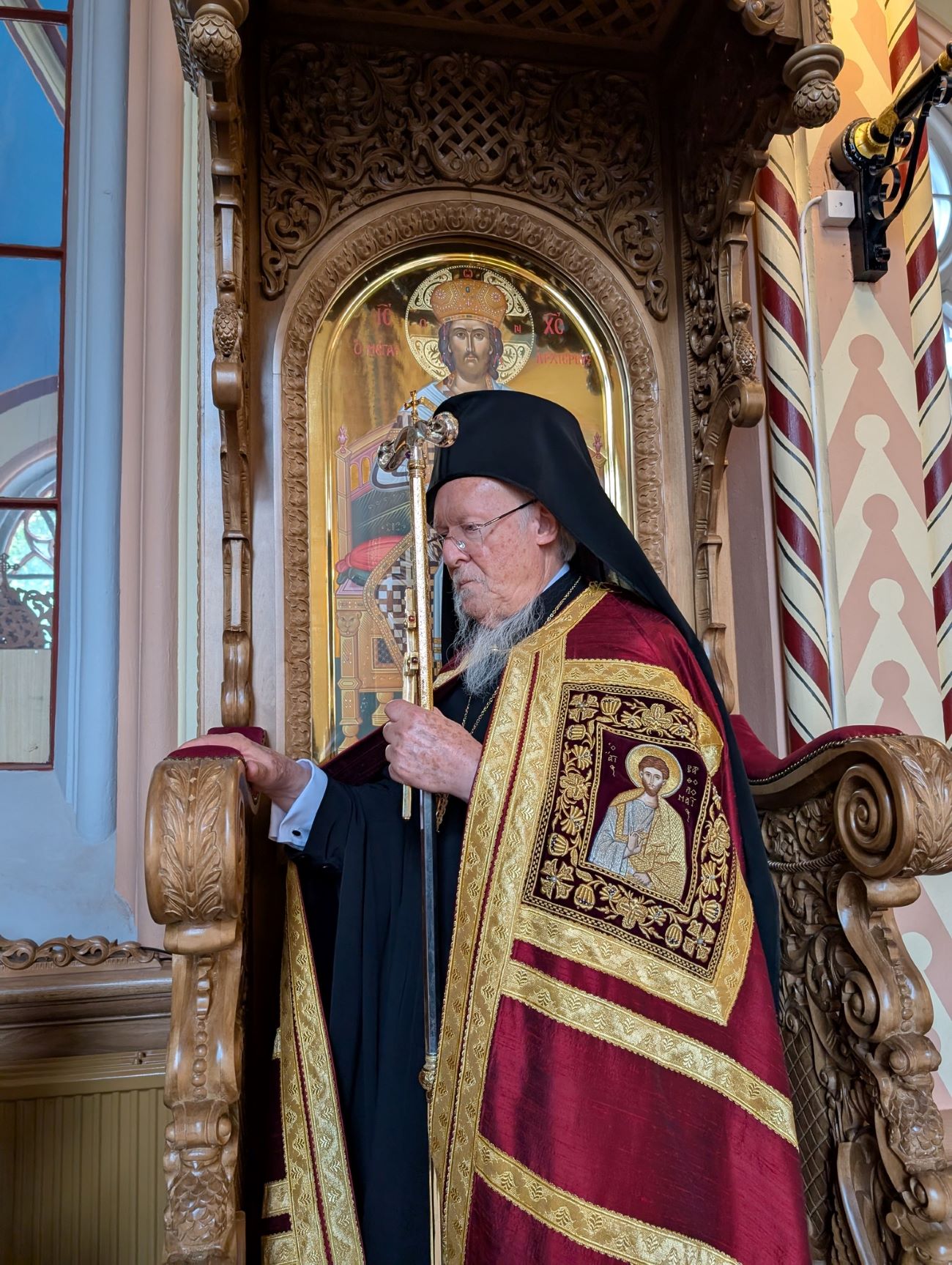
In a different context, yet with similar ethical content, the work of Ecumenical Patriarch Bartholomew has internationally highlighted the importance of protecting Creation.
Patriarch Bartholomew was the religious leader to explicitly characterize environmental pollution as a “sin.” By using this term, he conferred upon the ecological issue not only a social or scientific, but a profoundly spiritual and moral dimension.
In his addresses he has emphasized, among other things: “To commit a crime against nature is a sin, because we destroy God’s gift to humanity.” “To destroy the natural environment means to sin against God, against our neighbor, and against future generations.” “The earth does not belong to us. It has been given to us as a gift, which we are obliged to hand on intact to those who come after us.” “The world does not belong to us; it has been entrusted to us as a gift for stewardship, not for exploitation.”
His ecological vision is not limited to moral exhortations but is grounded theologically. The human being is a steward of Creation, not its master; therefore, the abuse of natural resources constitutes not merely an ecological error, but a spiritual deviation.
According to Patriarch Bartholomew, the ecological crisis is not simply a technological failure, but a spiritual distortion of humanity’s relationship with the world.
The international environmental symposia he organized on seas, rivers, and ecosystems around the world aimed, as he repeatedly stated, “to awaken the conscience of humanity to the sacredness of Creation.” These are not merely informational initiatives, but a coherent theological proposal. Humanity is not the owner of nature but its steward.
For this reason, he has justly been given internationally the title “the Green Patriarch!”
The ecological theology and sensitivity of Patriarch Bartholomew are not a modern invention but are rooted in the Biblical and Patristic Tradition of the Church.
In the Book of Genesis we read: “And God saw everything that He had made, and behold, it was very good” (Gen. 1:31). Creation is by nature good and sacred, presented as a holy gift, not as an object of arbitrary exploitation. Humanity is placed in Paradise “to till it and to keep it” (Gen. 2:15), that is, not to destroy and plunder it, but to cultivate and protect it.
The Fathers of the Church reaffirm this understanding. St. Basil the Great, in his “Hexaemeron,” presents nature as a space for the manifestation of God’s wisdom (theophany) and calls upon humanity to respect every creature: “From the visible, the invisible is understood.” Creation leads humanity to knowledge of God and therefore demands reverence, not contempt.
St. John Chrysostom condemns greed and the abusive exploitation of goods, emphasizing that the world belongs to all and not to a few: “Nature does not suffer from lack; rather, it is human greed that is deficient.” The problem is not creation but human avarice.
St. Maximus the Confessor views all of creation as a unified organism, in which human sin disrupts the harmony of the whole. He regards humanity as the bond of unity of all creation. Humanity is called to unite creation with God, not to disintegrate it.
St. Isaac the Syrian expresses a profoundly moving ecological spirituality: “A merciful heart burns with love for the whole of creation… for human beings, for animals, for birds, for every creature.” These words resonate directly with contemporary ecological sensitivity.
In this light, the ecological crisis is not merely a technical problem, but a spiritual crisis in humanity’s relationship with God, the world, and neighbor.
It is striking that this same fundamental idea reappears in contemporary theology, philosophy, and science. The late Professor Christos Yannaras noted that modern humanity turns nature into an object of consumption, losing the relationship of communion with it. The ecological crisis, in his thought, is the fruit of a civilization severed from the ethos of eucharistic relationship with the world.
The late Metropolitan John (Zizioulas) of Pergamon emphasized that the ecological crisis is primarily a crisis of culture and relationship, not merely an environmental problem.
The biologist E. O. Wilson, one of the most significant scientists of biodiversity, argued that humanity bears moral responsibility toward every form of life, not only for reasons of survival but for reasons of intrinsic value.
The environmentalist Rachel Carson, in her emblematic work “Silent Spring,” showed that human arrogance toward nature inevitably leads to self-destruction.
The philosopher Hans Jonas formulated the “Principle of Responsibility,” according to which every human action must take into account its consequences for future generations and for the planet.
Even outside a religious framework, contemporary scientific thought increasingly recognizes that the ecological crisis is a moral issue of global responsibility.
Although Erin Brockovich acts on a legal and social level, while Patriarch Bartholomew operates on a spiritual and theological level, these two approaches converge on essential points.
Erin Brockovich expresses, on a secular level, the same moral concern that Patriarch Bartholomew articulates in theological language.
Both denounce environmental pollution as a form of injustice.
Both defend the victims: vulnerable communities, future generations, and the planet itself.
Both issue a call for personal responsibility and collective awakening.
In both cases, environmental protection is linked with moral conscience and human dignity.
Erin Brockovich defends people who have suffered from environmental contamination, while Patriarch Bartholomew defends the entirety of creation as a victim of human arrogance.
The film “Erin Brockovich” functions as a contemporary social parable. It reveals that environmental injustice is a form of sin against humanity, while the Ecumenical Patriarch gives the same issue theological depth; the ecological crisis is a spiritual crisis.
Erin Brockovich and the work of Ecumenical Patriarch Bartholomew, though originating from different spheres, converge in a common message: the protection of the environment is an act of justice, responsibility, and profound moral significance. Pollution does not only destroy nature; it wounds humanity and offends Creation itself.
The film constitutes a modern narrative of moral struggle. Its content transcends the boundaries of social protest and raises deeper questions about humanity’s relationship with nature, responsibility, and justice.
Its message gains even greater depth when placed in dialogue with the work of Ecumenical Patriarch Bartholomew, Patristic Theology, and contemporary spiritual and scientific thought, because they all converge on one fundamental point; the destruction of nature is not merely a technical error but a deep failure of human conscience.
The film reveals the human dimension of ecological injustice. Theology offers its spiritual depth. Science confirms the destructive consequences. Together they form a powerful call to responsibility.
In a world where the ecological crisis is intensifying, such voices—whether arising from cinema or from the Church—remind us that responsibility for the future of the planet is not an option but a duty. Humanity is called not to be a tyrant and violator of nature, but a humble guardian of a divine and inestimable gift.