

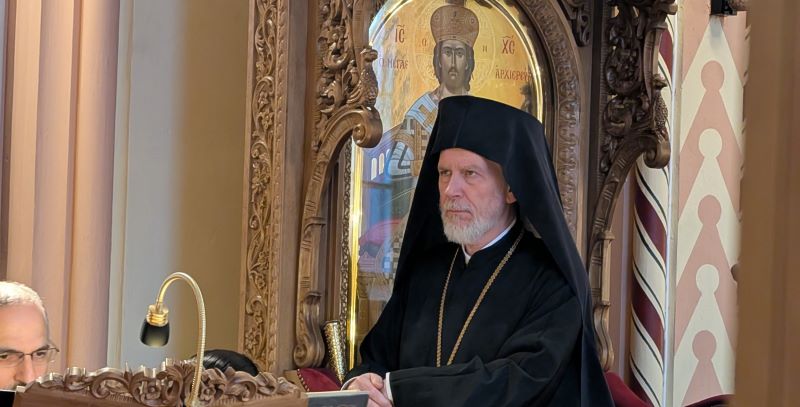
Sunday, January 25, 2026
Your Grace,
Dearly Beloved Brothers and Sisters in Christ,
Today the Church places before us the luminous figure of Zacchaeus, the chief tax collector, as recorded in the Gospel of Luke. Though short in stature, Zacchaeus stands tall in the spiritual vision of the Church, for his encounter with Christ reveals the path of repentance, humility, and salvation.
Saint John Chrysostom observes that Zacchaeus’ desire to see Christ was already a sign that grace was at work within him before Christ entered his house.
Zacchaeus climbs the sycamore tree not out of curiosity alone, but out of a deep inner hunger. This tree becomes for him a ladder of humility.
Zacchaeus ascends the tree only after he lowers himself in humility. As Saint Ephrem the Syrian teaches, “Humility is the dwelling place of grace.” Where humility is found, Christ draws near.
The most astonishing moment in the Gospel is that Christ sees Zacchaeus. Saint Cyril of Alexandria emphasizes that Christ calls Zacchaeus by name, demonstrating that no sinner is anonymous before God. The Lord does not say, “If you repent, I will come,” but rather, “Today I must stay at your house.”
Divine grace precedes human reform. The visitation of Christ is the cause of repentance, not its reward. This is the pattern of salvation proclaimed by the Orthodox Church: God descends first. Man responds.
Zacchaeus’ repentance is not emotional sentiment, but concrete transformation. “Behold, Lord, the half of my goods I give to the poor; and if I have taken anything from anyone by false accusation, I restore fourfold.”
Saint Basil the Great teaches that repentance must include both confession of sin and restoration of justice. The heart touched by Christ becomes generous, merciful, and just.
Christ declares: “Today salvation has come to this house.” According to Saint Gregory Palamas, the “house” is not only Zacchaeus’ dwelling place, but his entire inner life; his mind, his will, his heart. When Christ enters, the soul becomes a temple of the Holy Spirit.
Thus, this Gospel confronts each of us with a direct question: Has Christ entered the house of our heart? Or do we still stand hidden in the crowd, content merely to observe Him from afar?
The Lord concludes: “For the Son of Man has come to seek and save the lost.”
No one is beyond the reach of divine mercy. No life is too broken. The very presence of Zacchaeus in the Gospel is a perpetual proclamation that repentance remains possible until the final breath.
As we approach the season of the Triodion and prepare for Great Lent, the Church places Zacchaeus before us as the first call to repentance.
Let us imitate his eagerness, his humility, and his generosity, so that Christ may also say to each of us: “Today salvation has come to this house!”