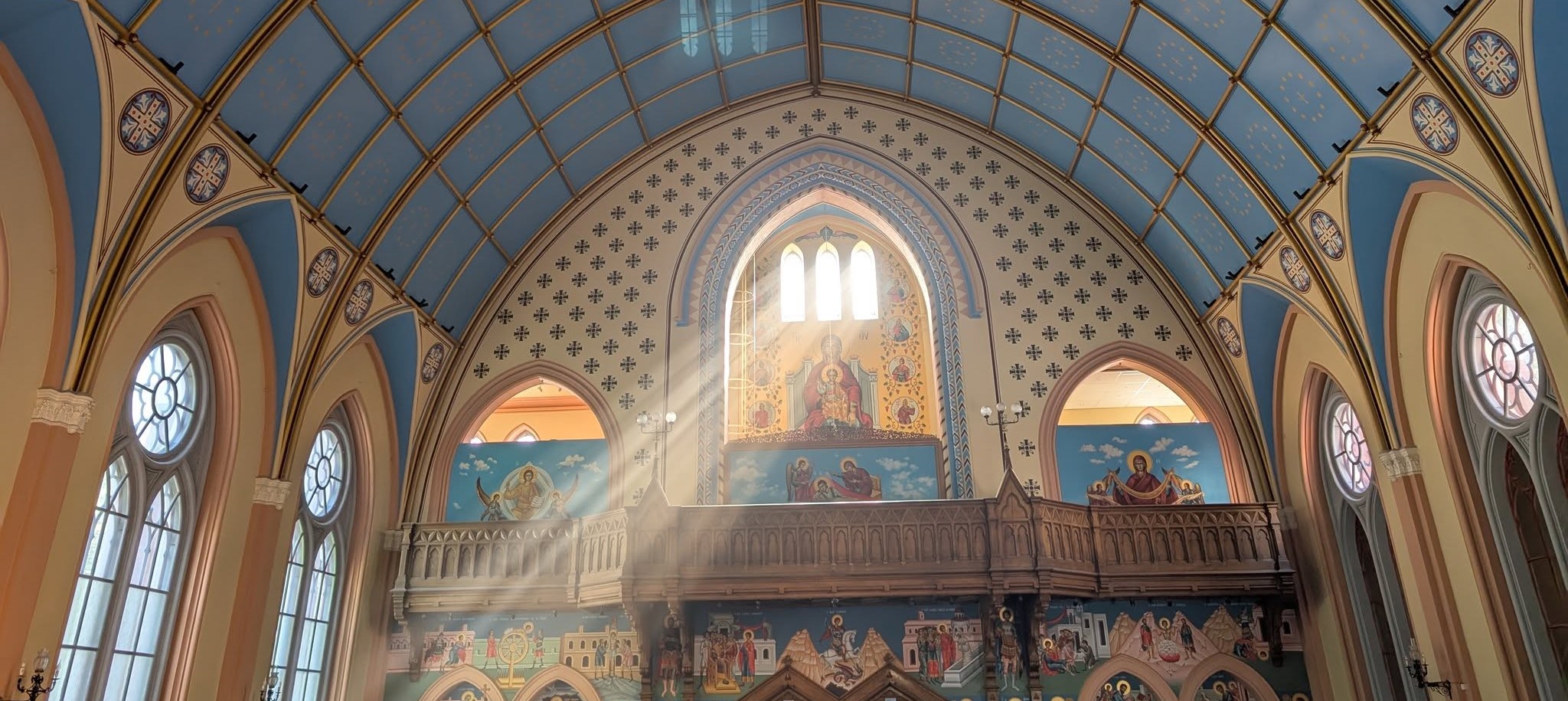
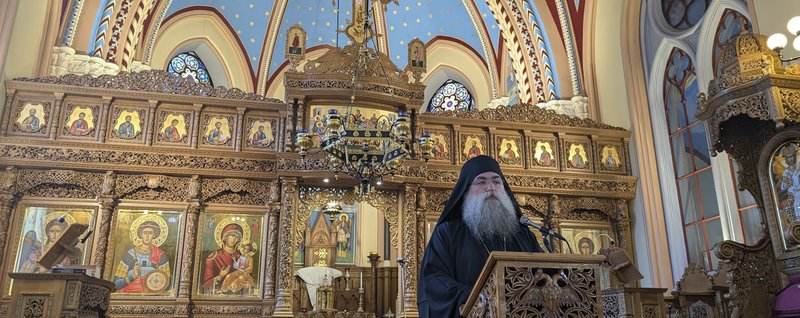
Saint George Cathedral of Stockholm
Saturday, May 2nd, 2026
First of all, I would like to express my heartfelt thanks to His Eminence Metropolitan Cleopas of Sweden for his gracious invitation and for the blessing of being with you today, here in the North, in this missionary Metropolis of the Ecumenical Patriarchate.
In our modern age, the message of the Gospel, the word of Christ, remains timeless. It is not bound by place or time; it transcends both and remains forever relevant. The task of the Church is to bring this message into the present age, into contemporary society, and into the life of the modern human person.
Today, when science and technology have advanced so rapidly, the Church stands before a great challenge: how to proclaim her message in a way that can truly inspire modern people and help them understand that spiritual life is not a luxury, but a vital necessity for everyday life. This requires us to overcome rigid habits and to speak in a language that people today can understand, without ever compromising the truth of our faith. Truth itself does not change; yet it always finds ways to become tangible and accessible. The goal is not simply to speak the truth, but to make it possible for others to hear it. And this demands effort, dialogue, and genuine openness, so that truth may become lived experience and not merely words.
In daily life, every person is governed by a number of obligations. These obligations are concrete: marital, family, social, professional, and spiritual. Yet daily pressures, constant busyness, and ever-increasing demands often leave little time for everything. Something must be neglected. And usually, the easiest thing to set aside is the spiritual life.
In this way, the external world begins to dominate the inner world. This shows that our priorities have not been rightly ordered, and that we have not fully understood how these different responsibilities interact, influence one another, and depend on one another.
Almost all of our obligations concern the outer world, except the spiritual ones, which concern the inner world. And yet it is precisely the state of this inner world that directly and decisively affects everything outward. Spiritual responsibility is the struggle for the soul; it is the effort to restrain our egoism, so that we may remain faithful also in our other responsibilities, without losing sight of the true purpose of life.
If a person neglects his spiritual state, how will he live in harmony with his wife, or her husband? How will there be real communication within the family? How will one be consistent, kind, approachable, and ready to communicate with one’s fellow human beings? How will one deal in the workplace with a superior, a business partner, or an employee?
But when there is a right balance among all our obligations, then the spiritual one naturally assumes its proper place: it becomes central, and it begins to shape the whole of human life.
The relationship between the inner and the outer life may be seen clearly in the image of a shield. The quality of the shield itself—its material, its design, its craftsmanship—is not enough on its own. Its value depends on the hand that holds it. As long as the hand is strong, the shield protects. But when the hand grows weak, the shield falls; and not only does it fail to protect, but it can even become dangerous and wound the very person it was meant to defend.
So it is in life. When the inner person is strong, then the outer world also comes into order. But when the inner person weakens, then even those things we once considered our protection can turn against us.
Spiritual responsibility means caring for the inner person. It means allowing God to enter into one’s life. Then inner peace begins to take root, the mind is cleansed, strength for the struggle is born, and love begins once again to breathe its fragrance.
And within this reality—where the inner person is often neglected, while the outer world dictates the rhythm of life—a crucial question arises: How can a person today stand firm, breathe again, and rediscover the meaning of life? What is that spiritual support which does not depend on circumstances, on time, or on technology, but touches the very center of human existence?
The Church, through all the centuries, offers a path both simple and profound: the path of prayer. Not as an escape from the world, but as a way of being fully present within it. Not as an abstract theory, but as a living relationship that strengthens, heals, and transforms the human person.
We live in an age in which the speed of information often exceeds the endurance of the soul. We communicate constantly, yet we do not always truly connect. We are endlessly informed, yet often without direction. Our phones rarely fall silent. News changes by the minute. Daily life can feel like an endless race.
And yet, in the midst of all this, modern people—though they may possess many things—often lack the one thing that matters most: peace. Eventually they become exhausted. They come face to face with their limits: with pain, with loss, with uncertainty, with the fear of tomorrow. And then deeper questions arise—existential questions: Who hears me? Where can I stand? Where can I rest my heart?
Fear takes hold, because in the end nothing seems to offer lasting security. Thoughts overwhelm the mind and begin to rule one’s life.
And it is precisely there that prayer is born. Not as a habit. Not as a formal act. But as a cry of need, and as an act of trust.
It is the deep need to speak with the One who transcends all human weakness, so that the human heart may finally feel safe.
Imagine a small child alone in a dark room. He is afraid of the darkness. His thoughts create frightening images. He becomes distressed and begins to cry out for help. But the moment he senses that his father is near—and even more when he finds himself in his father’s embrace—everything changes. The fears vanish. The imagined threats disappear. A sense of safety is born. The child becomes calm, and even strong. And all of this happens because he feels secure in the presence of his father.
This is exactly what prayer is. It is the communication of the human person with God the Father. It is a relationship that gives birth to a sense of security, brings peace into the heart, and allows that peace to work deeply and powerfully in human life. The mind becomes clear. One begins to see more clearly. And what does one see? One’s own life—so that one may make true decisions, using the great gift of freedom, the gift of self-determination.
And here a deeply modern and profoundly existential question emerges: Does prayer still have a place in the life of modern man? Is it simply an outdated practice from the past, or is it perhaps one of the most dynamic—and even one of the most revolutionary—acts a human being can still make today?
In the end, reality itself shows us that prayer is necessary. It is the strength that enables us to endure reality, to interpret it, and ultimately to transform it.
And perhaps this is where the great problem of our time truly lies: not only in external difficulties, but in the deep crisis of interior life.
Our age is marked by a profound crisis of interiority. Not because human beings no longer have a soul, but because they have forgotten how to listen to it. They have stopped attending to it. Daily demands have multiplied so greatly that no time seems to remain for spiritual searching, for stillness, for prayer. In many cases, the inner life has become almost irrelevant—almost foreign—to daily existence.
We live under a true dictatorship of noise: notifications, messages, images, demands. The mind is constantly alert, but the heart is neglected. We are almost never truly alone with ourselves—and perhaps that is exactly what frightens us most.
The absence of prayer becomes visible in our restlessness, our anger, our anxiety, and our irritability. We look for solutions, yet inwardly we are clouded. And how can one discern right from wrong when there is no peace in the heart? When everything within is confused? When one no longer has the strength to listen or even to speak, and feels close to collapse? What solution can one seek when inner turmoil has already led to despair?
In such an environment, prayer is not a luxury. It is a necessity. One might even say it is a kind of spiritual detoxification. It is not merely a matter of words addressed to God. It is the silence that allows us to hear what is truly happening within us. It is living communion with Him.
The very word “prayer” means turning toward someone, addressing someone, drawing near to someone, and expressing a desire or a plea.
Prayer is not a monologue. It is relationship. It is not words thrown into the air. It is the opening of the heart to God.
The Fathers of the Church speak of prayer as the ascent of the mind to God—an inner journey from distraction to concentration, from agitation to peace, from “I want” to “I trust.”
True prayer does not first change the world around us. It changes us. Prayer is not passive. It is an act of resistance.
First, it is resistance to the extreme individualism of our age, which trains us constantly to say, “I.” Prayer draws us out of the narrow prison of the self and opens us to others. It teaches us to remember the sick, the poor, the stranger, the suffering, the neighbour. And this is how solidarity is born. Because no one is saved alone.
In the Lord’s Prayer—“Our Father”—which Christ Himself gave us as the model of prayer, there is one detail of great significance. The prayer does not begin with “My Father,” but with “Our Father.” From its very first word, prayer delivers us from selfishness. It reminds us that salvation is never merely individual, but ecclesial; we are saved as brothers and sisters, as members of the Church.
From the very first word, we are led away from the trap of “I” into the truth of “we.” We have one Father. Therefore, we are brothers and sisters. And this is inseparable from the commandment of love: “Love one another.”
At the same time, prayer is also resistance to despair. In a world wounded by wars, pandemics, social inequality, and the climate crisis, despair often appears more realistic than hope.
And yet prayer does not remove pain. It transforms it. It does not promise easy solutions. It gives strength to continue. And it says silently to every human heart: “You are not alone. I am here with you.”
That word “with” is not a small word. Christ Himself spoke it at the moment of His Ascension: “Behold, I am with you always.”
That promise drove away the despair that, humanly speaking, should have filled the hearts of the disciples. And that is why they returned with great joy: because their Lord was still with them.
And this same promise is given to us. We do not walk through life alone. Christ is with us—in joy and in sorrow, in strength and in weakness, in every hour of life. And how much consolation one may receive from this thought alone.
Then despair begins to depart, and hope returns. For despair is not fitting for the Christian. The Christian’s hope is Christ.
There is, however, also a danger: that we may turn prayer into a demand. That we may ask for solutions without repentance. That we may expect miracles without struggle.
In this way faith is in danger of becoming a kind of magic—a religion of formulas and methods, of numbers and guarantees, without personal effort, without repentance, without struggle. We simply demand and expect our problem to be solved.
But God does not respond to formulas. He responds to the pure heart. That is why the Psalmist does not ask merely for solutions, but for the transformation of the heart: “Create in me a clean heart, O God.”
Prayer therefore begins not with demand, but with repentance; not with insistence, but with trust. There is no technique for success in prayer. There is relationship.
Unfortunately, especially through the internet, we often hear people urging others to say “this specific prayer” in order to succeed, to gain wealth, to obtain what they desire, and many other false and deeply misleading things.
All this distorts prayer and turns it into a tool. It exploits ignorance, but above all it exploits human pain, anxiety, and uncertainty. It presents itself as a lifeline in the sea of life’s problems, where many feel they are drowning.
And the result is often either spiritual blindness and religious fanaticism, or else unbelief—when the prayer “did not work.”
One of our greatest mistakes is to confine prayer to a certain place or a certain moment. In reality, prayer can be everywhere. Even the simple words “Lord, have mercy” contain everything.
All patristic literature, all the services and supplications of the Church, in essence say the same thing: they are a cry of supplication to God. And this cry finds its purest expression in the simple and humble words: “Lord, have mercy.”
When someone says these words inwardly, no one around him hears. He disturbs no one—except the devil, whom he drives away, because he gives him no room to sow thoughts. In that moment, only two remain: the human person and the Lord whom he invokes.
Thus one communicates with God and receives a sense of security in daily life. “Lord, have mercy” can accompany a person everywhere: at home and on the road, at work and among friends, in the car, in the café, even in the stadium—in every moment of life.
This inner effort keeps a person spiritually alert. The peace that is born within gives him the ability to govern his life and the decisions he must make. He remains calm, recognizes his mistakes, and tries to correct them. Through patience, he inspires others. He becomes an example and a light, both in the family and in society, according to the word of Christ: “Let your light so shine before men, that they may see your good works and glorify your Father who is in heaven.”
And then, through the person who is being transformed inwardly, relationships begin to change, choices begin to change, and ultimately even the very way we live within society begins to change.
Yet if prayer is to remain alive and true, it must also be accompanied by discernment. Even the holiest thing can be distorted when it passes through human misunderstandings and unhealthy mentalities.
Often, especially in our own time, we see people invited to join in prayer at a specific hour for someone who is sick, or for some other serious need. At first glance this seems beautiful, and indeed it may express a desire for spiritual unity and support.
But here discernment is necessary. The danger is that people may begin to imagine that the miracle will come from that particular prayer of ours, rather than from the grace of God, which is not restricted by time and is not bound by human schedules or formulas.
So the question naturally arises: why limit prayer to one specific moment, instead of speaking of continual and unceasing prayer?
At any moment of the day, if a person calls upon God, God hears. Our faith is not a display of the “power” of our prayer. It is a way of life. It is the revelation of truth.
Prayer is not limited to isolated moments. It transcends time. It becomes unceasing—more constant even than our breathing.
And this truth leads a person to recognize his own weakness. And that is why he never ceases to cry out: “Have mercy on me, O God, according to Thy great mercy.”
His weakness does not crush him. Through constant communion with God, it becomes strength.
Saint Gregory the Theologian expresses this beautifully when he says: “We must remember God more often than we breathe.”
He is not speaking merely of an outward recollection of God, but of a continual inner remembrance—a state of heart and mind always turned toward Him. Prayer is no longer something occasional. It becomes a mode of existence. It transforms the inner person and keeps him alive in the world.
When the heart is closed, not even a hundred prayers are enough. But when the heart is open, a simple “Lord, have mercy” is enough.
Prayer does not require many words. Too many words can produce confusion and inner noise. Silence, on the other hand, cultivates peace, because silence reveals trust. And then prayer becomes true, because God knows who the person is, what he asks, and why he asks it.
Prayer rises from the heart with courage and trust, and the human person simply waits, guided by the words: “Thy will be done.” But this presupposes that one has cultivated a true relationship with God.
When God is a stranger to a person’s life, then in the hour of difficulty he does not ask—he demands. He expects an immediate answer. And because he does not know how God works, he quickly accuses Him.
But that is not boldness. It is presumption.
We do not make demands of someone we do not know. When we come to know someone, then we ask, and we wait. So it is also with God. When a person cultivates a relationship with Him, he comes to know Him, to trust Him, and simply to wait upon Him.
It becomes clear, then, that prayer is not outdated, nor is it a relic of the past. It does not prevent a person from living in the modern world. On the contrary, it liberates him. It does not remove him from reality, but gives him the strength to stand within reality with truth, discernment, and inner freedom.
The one who prays does not hide from the world. He lives within his daily life, works, struggles, meets others, and carries out his responsibilities—but he is not alone. He brings Christ with him as the companion of his journey. He strives to keep always on his lips and in his mind the prayer: “Lord Jesus Christ, have mercy on me.”
This prayer does not close him in on himself, nor make him fearful. On the contrary, it opens him. It illumines him inwardly, and through his own struggle it also illumines the world around him. Not through impressive speeches or theories, but through his manner of life, his patience, the peace he radiates, and his very presence.
For this reason, the Fathers of the Church understand prayer not as withdrawal from life, but as a way of life. Saint Isaac the Syrian teaches that inner prayer gives birth to peace in the heart and makes a person a light to others, because he is first illumined within himself.
And then, through the person who is being transformed within, the world around him also begins to be illumined.
Thus prayer becomes the breath of the soul. It becomes the strength that accompanies a person at every moment: in joy and in trial, in decisions and in dead ends, in weakness and in struggle. And in the end it becomes clear that prayer is not merely helpful, but absolutely necessary in human life, because it gives direction, freedom, and meaning.
And when prayer is true, it does not remain a theory. It becomes a way of life. It becomes a daily struggle.
So, let us leave this spiritual gathering today with one firm resolution: not to abandon our spiritual struggle. The Christian, like the athlete, is not judged by one isolated moment, but by steadfastness, perseverance, and faithfulness in the course. He falls, he grows tired, he becomes discouraged—but he does not give up. He rises again and continues, always keeping the goal before him.
He battles the demon of indifference that seeks to hold him back, and he continues on the path.
And this struggle does not remain theoretical. It takes flesh. It acquires substance.
And the way of this struggle is neither vague nor unknown. Christ Himself showed it to us. He gave it to us in the Lord’s Prayer, the “Our Father,” not only as words to be spoken, but as a way of life and a daily path. He also gave us the commandment of love—“Love one another”—as the foundation of our relationship with our neighbour.
There we learn who we are, and where we are going: children of one Father, brothers and sisters to one another, men and women striving to do the will of God, to live with trust, forgiveness, and hope. To communicate with one another. To smile.
The spiritual struggle does not ask for perfection. It asks for faith and repentance. It does not seek flawless people, but hearts that return to God.
This struggle of the heart is expressed beautifully in the well-known prayer of Saint Ephraim the Syrian: “O Lord and Master of my life.”
There we do not ask for success or easy solutions, but for purity of mind, humility, patience, and love—precisely what a human being needs in order to stand truthfully in this world.
And Christ is not merely the prize at the end of the road. He is our companion in the struggle. He is the One who strengthens us, supports us, and raises us up every time we fall.
Let us therefore place Him at the center of our lives. And then our struggle, however difficult it may be, will become a path of light, a path of life, a path of salvation. Christ does not ask for our perfection. He asks for our heart. And the one who gives his heart to Him is never lost.
The power of prayer in the twenty-first century is not measured by words, theories, or impressive declarations. It is measured by how much love, how much peace, and how much light we bring into our daily lives; by the way we stand before our fellow human beings; by the way we endure suffering; and by the way we live, even amid our contradictions and weaknesses.
It is not weakness to ask God for help. It is strength to recognize that we are not alone. It is humility that frees us from the burden of the ego, and trust that gives birth to peace in the heart.
In a world that is noisy, unstable, and often weary, let us make prayer the breath of our soul. Not as an obligation or a duty, but as a relationship. Not as an escape from reality, but as a way of being fully present within it. As a silent conversation with God, who keeps us standing and gives us direction.
For the one who prays does not withdraw from the world. He does not close himself off within himself. He returns to the world more human, more peaceful, more free. He returns bearing Christ within him as the companion of life; and without seeking it, without proclaiming it, he illumines the world around him by his very existence.
Christ is Risen!