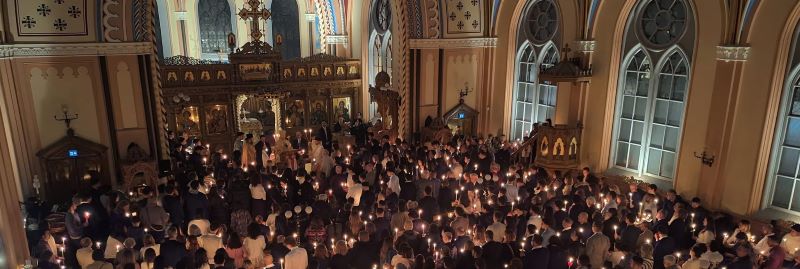
H.E. Metropolitan Cleopas of Sweden’s Homily at the 12th Catechumens’ Seminar
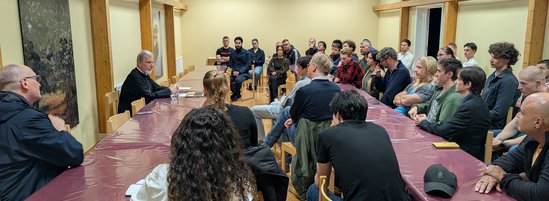
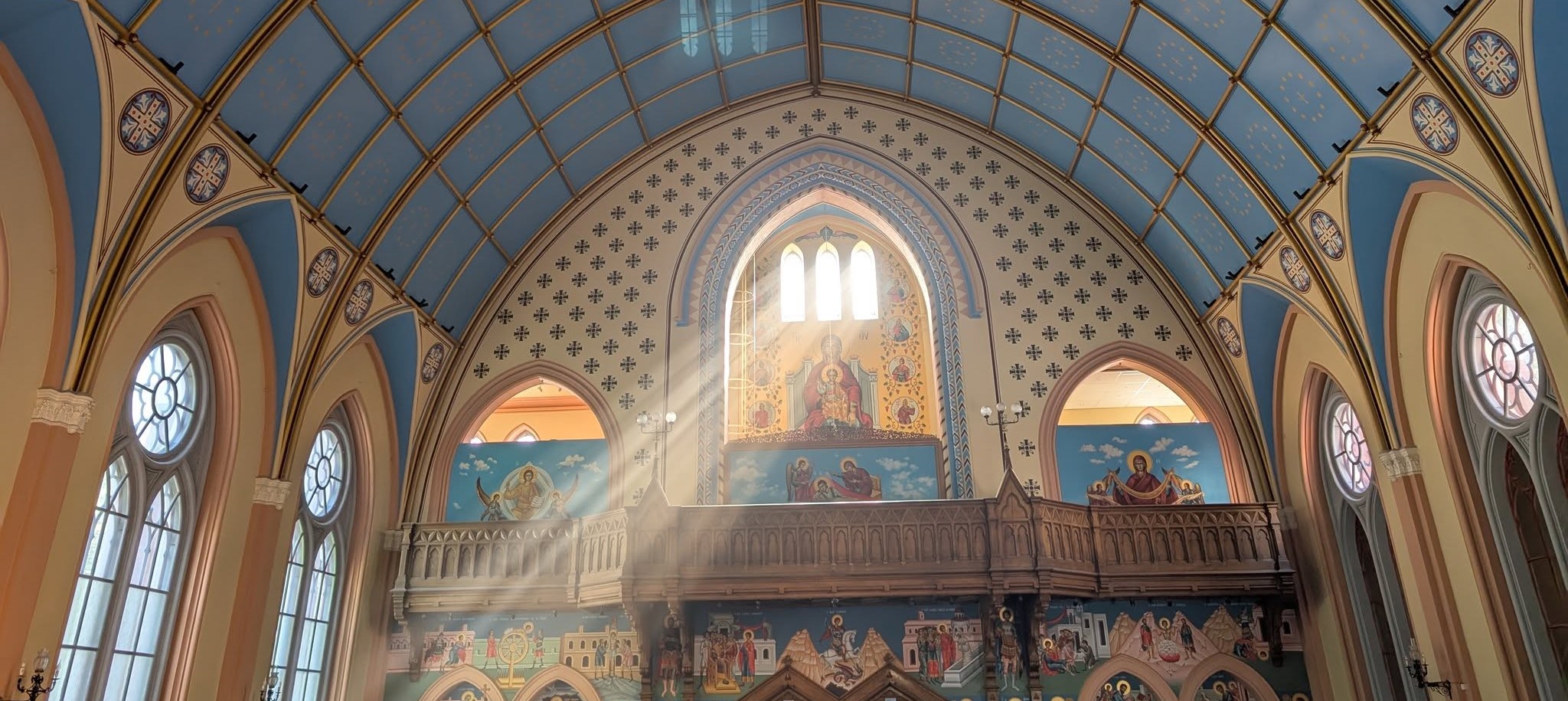
St. George Cathedral of Stockholm
Thursday, April 16, 2026
Dear Catechumens and newly illumined in Christ,
We stand together at the threshold of a mystery that is at once sorrowful and triumphant, hidden in ages past, yet revealed in fullness in these last days.
It is the mystery of our salvation; the passage from sacrifice to Resurrection, from the Cross to the empty tomb, from death to life.
This journey is not merely the story of Christ; it is the very shape of the Christian life into which you are now being initiated.
The Old Testament is not a closed book behind us, but a living prophecy fulfilled in Christ. When we read it in the light of the Resurrection, we begin to see that everything was pointing toward this moment; the Lamb who would be slain, the Servant who would suffer, the King who would reign through humility, and the God who would descend into death to shatter it from within.
Let us begin where God Himself begins; with sacrifice. In the book of Genesis, we encounter the first shadows of this mystery. Abel offers a sacrifice pleasing to God, a foreshadowing of the righteous One whose blood would cry out more powerfully than Abel’s.
Later, Abraham is called to offer Isaac, his beloved son, upon Mount Moriah. The knife is raised, the wood is laid, and yet at the last moment, God provides a ram in place of the child.
The Fathers of the Church saw clearly in this event not only a test of faith but a prophetic image, the beloved Son, willingly ascending the mountain of sacrifice, carrying the wood/the cross upon His shoulders, yet unlike Isaac, not spared at the final moment. For in Christ, God does not withhold His Son, but gives Him freely for the life of the world.

The sacrificial system of Israel was never an end in itself. It was a pedagogy, a preparation, a language through which God taught His people to recognize the cost of sin and the necessity of reconciliation.
The Passover lamb, whose blood marked the doorposts of Israel, becomes one of the clearest prefigurations of Christ. As the Israelites were delivered from death through the blood of the lamb, so we are delivered from the tyranny of death through the blood of Christ.
As they passed through the Red Sea into freedom, so we pass through the waters of baptism into new life.
Prophet Isaiah speaks with astonishing clarity of the suffering Servant: “He was despised and rejected by people, a man of sorrows and acquainted with grief… He was wounded for our transgressions, he was bruised for our iniquities… and by his stripes we are healed.”
Here, centuries before the Incarnation, we encounter a vision of the One who suffers not for His own sins, but for the sins of others.
The Church Fathers did not read this as mere poetry or metaphor; they recognized in these words the very face of Christ; the Lamb of God who takes away the sin of the world.
From the earliest pages of Scripture, God prepares His people to understand this mystery. The sacrifice of Abel, the offering of Isaac, the Passover lamb, and the prophetic vision of the Suffering Servant in Isaiah—all these are not isolated moments, but converging signs.
As the prophet Isaiah proclaims: “He was led as a sheep to the slaughter… and by His wounds we are healed.” The Church has always read these words as a direct unveiling of Christ’s Passion.
The Psalms, too, are filled with prophetic echoes. Psalm 22 cries out, “My God, my God, why have you forsaken me?”—words that Christ Himself spoke from the Cross. The same psalm describes hands and feet pierced, garments divided, and a suffering that seems unbearable, yet ends in praise and vindication.
Psalm 16 proclaims, “You will not abandon my soul to Hades, nor will you let your Holy One see corruption.” Here already is the seed of the Resurrection, the promise that death will not have the final word.
Saint Justin the Martyr, one of the earliest Church Fathers, wrote that “the mysteries of the Cross were prefigured in all righteous sacrifices,” teaching us that the Old Testament is not merely history but prophecy fulfilled in Christ.
When we come to the Passion, we behold the culmination of this divine economy. Christ is betrayed, condemned, crucified, and buried. Yet, as Saint John Chrysostom declares in one of his homilies: “I call Him King, because I see Him crucified.” For the Cross is not defeat, but enthronement; not humiliation, but glory hidden from worldly eyes.
Saint Gregory the Theologian deepens this mystery when he says: “Yesterday I was crucified with Him; today I am glorified with Him. Yesterday I died with Him; today I am made alive with Him.”
Here we see that the Passion is not something external to us; it is something we enter into. The Cross is not the end. If it were, our faith would remain incomplete. The fullness of the revelation comes in the Resurrection.
When we enter Holy Week, we are not simply remembering past events; we are entering into them mystically. The Bridegroom comes in the middle of the night. He is betrayed by a friend, abandoned by His disciples, judged unjustly, mocked, scourged, and condemned.
He carries His Cross to Golgotha, the place of the skull, where He is crucified between two thieves. The One through whom all things were made, hangs upon the wood of His own creation.
The Holy Fathers speak of this with a mixture of awe and trembling. How is it that the immortal dies? How is it that the Life of the world is laid in a tomb?
Saint Gregory the Theologian says that what is not assumed is not healed; therefore Christ assumes our full humanity—even to the point of death—so that He might heal it from within.
Saint Athanasios teaches that the Word of God became man so that man might become god—not by nature, but by grace, by participation in the divine life.
On the Cross, Christ offers Himself as a perfect sacrifice, not one imposed upon Him, but one freely given. This is crucial for us to understand. The sacrifice of Christ is the self-offering of divine love. It is the culmination of a life lived in total obedience and communion with the Father, a life poured out “for the life of the world.”
The Cross reveals both the depth of human sin and the greater depth of divine mercy. There, we see what sin does. It kills, it rejects, it crucifies the innocent, but we also see what God does. He forgives, He endures, He transforms suffering into salvation.
Even in His agony, Christ intercedes for those who crucify Him, when He said: “Father, forgive them, for they know not what they do.”
And yet, the story does not end at Golgotha. If it did, the Cross would remain a tragedy, a noble but ultimately defeated act. The Church proclaims something far more radical, that through His death, Christ tramples down death itself. This is the paradox at the heart of our faith, that death becomes the means by which death is destroyed.
After His final breath, Christ descends into Hades, not as a victim, but as a conqueror. The icon of the Resurrection in the Orthodox tradition does not depict the moment of Christ emerging from the tomb, but His descent into the depths, breaking the gates of Hades, lifting Adam and Eve from their graves.
This is not a private victory; it is cosmic in scope. All humanity, represented in Adam and Eve, is drawn up into the life of God.
The Resurrection is not simply the resuscitation of a corpse. It is the transfiguration of human nature, the beginning of a new creation. Christ rises not to return to His previous life, but to inaugurate a new mode of existence; one that is no longer subject to death, corruption, or decay. His risen body is real, tangible, yet glorified. He eats with His disciples, yet passes through closed doors. He is both the same and transformed.
Saint John Chrysostom, in his Paschal homily, proclaims with boldness: “Christ is risen, and not one dead remains in the tomb!” This is not a poetic exaggeration, but a theological declaration.
The Resurrection of Christ is the guarantee of our own resurrection. It is the first fruits of those who have fallen asleep, the pledge that death has been defeated once and for all.
For you, who are catechumens and newly illumined, this is not an abstract doctrine; it is your new reality. In baptism, you have been united to Christ in His death and Resurrection. As Apostle Paul writes, “Do you not know that all of us who have been baptized into Christ Jesus were baptized into his death? Therefore we were buried with him by baptism into death, so that, just as Christ was raised from the dead, we too might walk in newness of life.”
This means that the passage from sacrifice to Resurrection is not only something Christ has accomplished for you; it is something He now accomplishes in you. The old self, with its passions and sins, is crucified with Christ. The new self, renewed in the image of God, rises with Him. This is the beginning of a lifelong process of transformation, what the Holy Fathers call theosis, or deification.
But let us be clear. The path of the Christian life is not a bypass around the Cross. It is a participation in it. “If anyone would come after me,” Christ says, “let him deny himself, take up his cross, and follow me.”
The Cross in our lives may take many forms; suffering, struggle, sacrifice, the daily dying to our own ego and will. Yet, when united to Christ, these are no longer meaningless burdens; they become the very means of our sanctification.
We must contemplate carefully all the appearances of the Risen Christ, for they are not random events. Each one of them is unveiling a dimension of the Resurrection.
On the first day of the week, at dawn, the myrrh-bearing women come to the tomb. They find it empty. Christ first appears to Mary Magdalene (John 20:11–18). She does not recognize Him at once, but when He calls her by name—“Mary”—her eyes are opened. This moment reveals a profound truth; the Risen Christ is known personally, relationally. As Saint Gregory the Theologian later reflected, “She was looking at Him as a man, and she found Him as God.”
Shortly thereafter, Christ appears to the other women (Matthew 28:9–10), greeting them with “Rejoice!”—the first word of the Resurrection. Fear is replaced by joy. The Resurrection transforms human emotion itself.
He then appears to Simon Peter (Luke 24:34), though the Gospel gives few details. The Holy Fathers see in this a restoration of Peter after his denial. Saint John Chrysostom notes that Christ appears first to the one who fell most grievously, “that he might not despair.”
On the road to Emmaus (Luke 24:13–35), Christ walks with two disciples, Luke and Cleopas, who do not recognize Him. He interprets the Scriptures to them, showing how Moses and the Prophets spoke of His suffering and glory. Only in the breaking of the bread are their eyes opened.
Saint Theophylact comments that “Christ is recognized in the Eucharist,” revealing that Scripture and Sacrament together disclose the Risen Lord.
That same evening, Christ appears to the apostles in the upper room (John 20:19–23), passing through locked doors. He says, “Peace be with you,” and breathes on them, giving the Holy Spirit. Here, the Resurrection is shown as the beginning of the new creation, echoing the breath of life in Genesis.
A week later, He appears again, this time to Thomas (John 20:24–29). Thomas touches His wounds and confesses, “My Lord and my God!”
Saint Cyril of Alexandria writes that Christ preserves His wounds “as trophies of victory,” not signs of defeat. The Resurrection does not erase the Cross. It transfigures it.
In Galilee, by the Sea of Tiberias (John 21), Christ appears to the disciples while they are fishing. He prepares a meal for them and restores Peter with the threefold question: “Do you love me?”
Saint Augustine says that Peter’s love is healed in the very place of his denial, through encounter with the Risen Christ.
Christ also appears on a mountain in Galilee (Matthew 28:16–20), giving the Great Commission: “Go therefore and make disciples of all nations.” The Resurrection thus becomes mission; the life of the Church extending into the world.
Apostle Paul tells us that Christ appeared to more than five hundred brethren at once (1 Corinthians 15:6), and also to James, and finally to Paul himself. These appearances affirm that the Resurrection is a historical and communal reality.
Finally, after forty days, Christ ascends into heaven (Acts 1:1–11), blessing His disciples. Yet even this is not a departure in absence, but a new mode of presence.
Saint Athanasius the Great explains the cosmic significance of all this: “The Word of God came in His own person, because it was He alone who could recreate man, made after His Image.” And through the Resurrection, that recreation is accomplished.
Saint John of Damascus proclaims in his Paschal canon: “Yesterday I was buried with You, O Christ; today I rise with Your Resurrection.” This is not poetic symbolism; it is sacramental reality. In baptism, we have died and risen with Christ.
Contemporary Orthodox theologians, such as Father Alexander Schmemann, emphasize that the Resurrection is not simply proof of Christ’s divinity, but the revelation of life as communion with God. He writes that “Christianity is the announcement of the Resurrection, the joy of knowing that Christ is alive.”
What does all this mean for you? It means that your life is now shaped by this same movement; from sacrifice to Resurrection.
You are called to recognize Christ as Mary Magdalene did, in the intimacy of His voice.
You are called to journey with Him like the disciples on the road to Emmaus, to have your hearts burn within you.
You are called to confess Him as Thomas did; not with doubt, but with faith born of encounter.
You are also called to bear your cross.
Saint Isaac the Syrian teaches: “Without temptations, no one can enter the Kingdom of Heaven.” Yet he immediately adds that “these trials become light when born in Christ.”
The Church places on the lips of Saint John Chrysostom these triumphant words in the Paschal homily: “Let no one fear death, for the death of the Savior has set us free. He that was held prisoner of it has annihilated it. Christ is risen, and the demons are fallen. Christ is risen, and the angels rejoice. Christ is risen, and life reigns!”
We are no longer merely seekers, we are participants. Therefore, live as people of the Resurrection. Let your lives bear witness that death has been conquered, that sin has been forgiven, that love is stronger than the grave.
Do not fear sacrifice, for it leads to glory. Do not despair in suffering, for it is transformed. Do not doubt the promise, for Christ Himself has fulfilled it.
We are called even now to live as people of the Resurrection, to embody joy, hope, and love in a world still marked by death. This does not mean denying the reality of suffering, but seeing it in the light of Christ’s victory. It means trusting that no darkness is so deep that it cannot be illumined by the light of the Resurrection.
The liturgical life of the Church sustains us in this journey. Each Divine Liturgy is a participation in the sacrifice and Resurrection of Christ. We offer bread and wine, the fruits of the earth and of human labor, and they become for us the Body and Blood of Christ. In this Holy Sacrament, heaven and earth are united, and we are nourished with the very life of God.
As you continue your journey in the Church, remember that you are not alone. You are surrounded by a great cloud of witnesses; the saints, the martyrs, the confessors, the righteous of every age, who have walked this path before you. Their lives bear witness to the truth that the way of the Cross leads indeed to the glory of the Resurrection.
The movement from sacrifice to Resurrection is the heartbeat of our faith. It is the rhythm of the liturgical year, the structure of the Scriptures, the pattern of the Christian life. It is the mystery into which you have been initiated, the gift you have received, and the calling you now bear.
Christ did not rise as an abstract spirit, but as a human being, bearing wounds, yet glorified. This means that the human body, the human person, is not disposable, not reducible to utility or profit. Every victim of violence, every exploited child, every forgotten poor person, each one is of infinite worth, because Christ has united Himself to humanity and raised it to divine glory.
Saint Gregory of Nyssa speaks with remarkable clarity: “Man is a being of inestimable value, for he has been created in the image of God.” The Resurrection confirms this value eternally.
The Resurrection proclaims that injustice and evil are not ultimate. When we see war, exploitation, and suffering, we may be tempted to despair, to believe that darkness is stronger than light, but the empty tomb stands as a contradiction to that despair. It tells us that even when evil appears victorious—as it did on Golgotha—it is already defeated in the reality of God.
Saint Maximus the Confessor teaches that Christ “recapitulates all things in Himself,” healing and restoring what has been broken. This includes not only individual souls, but the entire fabric of human existence.
The Resurrection calls us also to responsibility. We cannot proclaim “Christ is risen” and remain indifferent to the suffering of the world. To believe in the Resurrection is to become witnesses of it, not only in words, but in deeds.
The Resurrection calls us out of selfishness, out of isolation, into love. And love, in a broken world, always takes concrete form; in mercy, in justice, in solidarity with the suffering.
To affirm the Resurrection, therefore, is to stand against everything that denies life.
It is to oppose the commodification of human beings in trafficking.
It is to resist systems that crush the poor.
It is to uphold the dignity of every person, regardless of status, race, or condition.
It is to become, in however small a way, bearers of the light of Christ in places of darkness.
Saint John Chrysostom, with his characteristic boldness, exhorts us: “If you cannot find Christ in the beggar at the church door, you will not find Him in the chalice.”
This is the ethical consequence of the Resurrection. The One who is risen is present in the least of our brothers and sisters.
And yet, even as we take responsibility, we do not lose hope. For the Resurrection is not dependent on our strength; it is the work of God already accomplished. We are not saving the world by our own efforts; we are participating in the salvation already given in Christ.
Saint Seraphim of Sarov greeted everyone with the words: “Christ is risen, my joy!” He saw the Resurrection not as an idea, but as a living reality that transforms how we see every person, every moment.
This is the message we are called to carry into the modern world, that life is stronger than death, that love is stronger than hatred, that dignity is stronger than exploitation, that hope is stronger than despair.
We are called to live as people of the Resurrection, not by ignoring the wounds of the world, but by entering them with the light of Christ.
When you encounter suffering, remember the Cross.
When you encounter despair, remember the empty tomb.
When you encounter injustice, remember that Christ is risen, and that His Kingdom has already begun.
The movement from sacrifice to Resurrection is not only the story of Christ; it is the answer to the deepest crises of our time.