

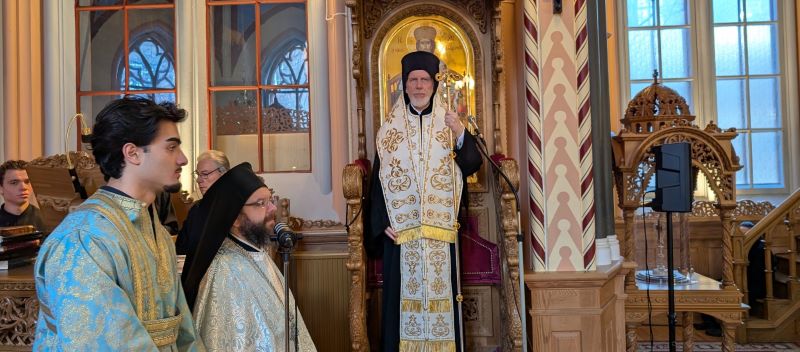
St. George Cathedral of Stockholm
Sunday, November 23, 2025
Dearly Beloved Brothers and Sisters in Christ,
Let us reflect upon two radiant feasts that illuminate the entire mystery of salvation, the Entrance of the Most Holy Theotokos into the Temple and the Nativity of our Lord Jesus Christ.
At first glance, these feasts may appear to stand far apart—one in November, the other at the brink of winter. Yet the Fathers teach us that they form a single arc in the divine story: the preparation and the fulfillment, the quiet beginning and the glorious revelation, the sowing and the harvest of salvation.
In the Entrance of the Theotokos, the Church shows us the quiet and hidden preparation of salvation. St. Gregory Palamas says that in her, “all the ages found their perfection,” for she is the one through whom God will enter creation. Her footsteps into the Temple are the first earthly signs of the “coming of the fullness of time.”
In the Nativity of Christ, that which was hidden is revealed. St. John Chrysostom proclaims that on this day “the earth becomes heaven,” for God Himself takes flesh. What the Entrance begins, the Nativity completes; what is offered in purity within the Temple becomes incarnate as the Savior of the world.
At her Entrance, the three-year-old Mary enters the Temple, but the Fathers repeatedly remind us that she is herself the true Temple. St. Andrew of Crete calls her “the Temple that contained God not in shadow, but in truth.” The Temple receives her, but only as a symbol receives its fulfillment.
At Christmas, we see this fulfilled when the Temple gives birth to the God who dwells within it. The one who entered the Temple now becomes the Mother of the Temple’s Lord. St. Ephraim the Syrian says, “The heavens cannot contain Him, yet a pure maiden’s womb has received Him.”
The Entrance reveals the Temple being prepared; the Nativity reveals the God who sanctifies the Temple.
In the Entrance, Mary is offered freely by her parents, Joachim and Anna, as a gift to God. St. Germanos of Constantinople writes that in her entrance, “humanity offers back to God its first truly spotless fruit.”
In the Nativity, God offers Himself as a gift to humanity. What Joachim and Anna did in symbol, God does in reality. The Fathers stand amazed: the one offered in the Temple becomes the one who offers Himself on behalf of all. The Entrance is the offering of the pure vessel; the Nativity is the outpouring of the divine treasure.
The Entrance is shrouded in silence. No crowds, no trumpets—only the quiet marvel of the angels, who, according to tradition, feed the child Mary with heavenly bread. St. Gregory of Nyssa tells us that “God delights to work in secret that which He later reveals in glory.”
The Nativity, by contrast, resounds with proclamation—angels singing to shepherds, a star calling magi, heaven and earth rejoicing. The silence of the Temple prepares the song of Bethlehem. What begins in stillness ends in cosmic praise.
In the Temple, Mary is formed—physically, spiritually, and mystically. The Fathers describe her upbringing as a continual ascent into holiness. St. John of Damascus writes that she “grew like a lily in the midst of thorns.”
At the Nativity, she becomes the fulfillment of that formation. The one formed in holiness now brings forth “the Holy One of Israel.” All her preparation leads to this moment when she becomes not only the Temple but the Gate through which God enters the world.
During the Entrance, little Mary ascends the steps of the Temple, climbing toward the Holy of Holies. This ascent is the icon of humanity rising slowly toward God, yearning for communion with Him.
At the Nativity, in a divine paradox, God descends the steps of heaven, born in a cave, laid in a manger, clothed in humility. What Mary does in miniature—ascending—Christ does in majesty—descending. The Entrance shows humanity seeking God; Christmas shows God seeking humanity.
In her Entrance, Mary is preserved in virginity as a living sign that God is preparing something utterly new. The Fathers emphasize that she is the “ever-virgin” not merely for purity, but to show that the coming salvation is not of human effort but of divine grace.
In the Nativity, this mystery reaches its summit: the Virgin gives birth, and her virginity remains intact. St. Ambrose famously teaches, “He entered the world through closed doors, and He left the tomb in the same way.” The Entrance reveals the virgin prepared; the Nativity reveals the virgin overshadowed by the Holy Spirit.
Therefore, the Entrance and the Nativity are not two separate stories but one mystery of love: The Temple is prepared; the Lord enters it. The Virgin is offered; God offers Himself. Silence prepares the hymn; the hymn reveals the mystery. Humanity ascends; God descends.
The Entrance gives us Mary, ready to receive God. The Nativity gives us Christ, ready to save humanity. In both feasts, God shows His humility and His lavish love; and in both feasts, humanity is invited to respond.
May we, like the Theotokos, become temples prepared for Christ. May we, like the shepherds, hasten to meet Him. And may the One born in Bethlehem also be born in our hearts. Amen!