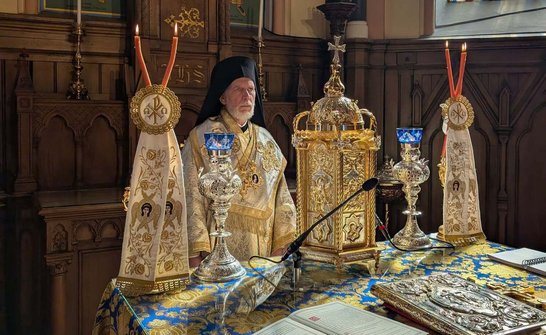
St. George Cathedral of Stockholm
August 6, 2026
Dearly Beloved Brothers and Sisters in Christ,
On the holy feast of the Transfiguration, the Church invites us to ascend spiritually with Peter, James, and John to Mount Tabor. There, before the eyes of His disciples, Christ “was transfigured before them; His face shone like the sun, and His clothes became white as the light” (Matthew 17:2).
The Lord did not become something He had not been before. He did not receive a glory that He had previously lacked. Rather, for a few moments, He allowed His disciples to behold the divine glory that had always belonged to Him. Their spiritual eyes were opened, and they saw, as much as they were able to bear, the uncreated light of His divinity.


This light was not ordinary, material light. It was not created like the light of the sun or the stars. It was the eternal and uncreated energy of God; His grace, His glory, and His living presence.
The divine essence remains inaccessible and incomprehensible, but through His uncreated energies God truly communicates Himself to humanity. He does not merely teach us about Himself from a distance; He enters our lives, purifies our hearts, enlightens our minds, and makes us, as the Apostle Peter writes, “partakers of the divine nature” (2 Peter 1:4). This is the mystery of theosis, the ultimate purpose of human existence.
Saint Gregory Palamas became the great theologian and witness of this mystery. He did not speak about the uncreated light merely as an intellectual theory. Through ascetic struggle, inner stillness, repentance, and the unceasing invocation of the name of Christ, he became a partaker of the divine grace that he later defended.
When some claimed that the light seen by the Apostles on Mount Tabor was created, Saint Gregory proclaimed that it was the uncreated glory of God Himself. The saints do not behold the divine essence, for this belongs to God alone; nevertheless, they truly participate in His uncreated energies. Thus, the vision of God is not an exercise of the imagination, nor is it the achievement of human reasoning. It is a gift of grace bestowed upon the purified and humble heart.
Several centuries later, this same truth was revealed with extraordinary clarity in the life of Saint Seraphim of Sarov. During his well-known conversation with Nicholas Motovilov, in a snow-covered Russian forest, Saint Seraphim prayed that his spiritual child might understand what it means to acquire the Holy Spirit. Suddenly, Motovilov saw the Saint’s face shining more brightly than the sun. The entire place was filled with light, peace, warmth, and an indescribable spiritual joy. Saint Seraphim explained that they were both, at that moment, in the fullness of the Holy Spirit. The light surrounding him was not his own; it was the light of Christ dwelling within him.
The experience of Saint Seraphim reveals something essential: the uncreated light is inseparable from the presence of the Holy Spirit. It is not given to satisfy curiosity or to reward spiritual ambition. It is not the result of a technique. Saint Seraphim did not seek visions; he sought Christ. He spent years in repentance, prayer, fasting, silence, and love. The light appeared as the fruit of his complete surrender to God. Moreover, the clearest evidence that he had become a bearer of divine light was not merely that his face shone, but that his heart overflowed with peace, compassion, and Paschal joy. He greeted every person with the words, “My joy, Christ is risen!” The light he had received became love for every human being.
The same light also shone in the life of Saint Nectarios of Pentapolis. His participation in the glory of Christ was revealed especially through the purity of his heart, the depth of his prayer, and his extraordinary humility. Saint Nectarios endured injustice, slander, humiliation, poverty, exile, and illness. Yet he refused to allow the darkness of bitterness to enter his soul. He answered persecution with silence, accusation with forgiveness, and rejection with prayer. Through patient endurance, his heart became a dwelling place of the Holy Spirit.
Saint Nectarios taught that the divine light illumines the pure heart and the purified intellect. His words were confirmed by his own life. Those who approached him encountered a man filled with peace, spiritual sweetness, discernment, and grace. His countenance radiated the holiness of one who lived continually in the presence of God. In him, the light of Tabor became visible not principally through an outward spectacle, but through a life transfigured by humility, patience, forgiveness, and sacrificial love. The world attempted to cover him with the darkness of falsehood, but Christ made him a radiant lamp whose light now shines throughout the entire world.
Saint Gregory Palamas, Saint Seraphim of Sarov, and Saint Nectarios of Pentapolis lived in different centuries and different lands. Yet all three became partakers of the same uncreated light of the transfigured Christ. Saint Gregory explained and defended this light through Orthodox theology. Saint Seraphim revealed it visibly through the grace of the Holy Spirit. Saint Nectarios manifested it through the radiance of a purified heart and a life of patient, forgiving love. In all three, we see that holiness is the transfiguration of the human person by divine grace.
The feast of the Transfiguration is therefore not simply the remembrance of an event that occurred long ago. It reveals the calling of every Christian. We may not be granted a visible experience of the uncreated light, but we are all called to become children of light. Every sincere prayer, every act of repentance, every victory over selfishness, every act of forgiveness, and every worthy participation in the Holy Eucharist opens our hearts to the transforming grace of God. Whenever hatred is replaced by love, pride by humility, despair by hope, and darkness by faith, the light of Christ begins to shine within us.
However, we must never seek extraordinary experiences. The saints sought repentance, not visions; humility, not admiration; Christ, not spiritual satisfaction. The light was given to them because they had emptied themselves of pride and had offered their entire lives to God. The safest path toward illumination remains the path of the Gospel: prayer, repentance, participation in the sacramental life of the Church, obedience to the commandments, forgiveness of our enemies, and love for all people.
Like the Apostles, we must also descend from Mount Tabor and return to the suffering world. We cannot remain on the mountain contemplating the light while our brothers and sisters live in darkness, loneliness, poverty, and pain. The true witness of the Transfiguration is to carry the light of Christ into our families, our parishes, our communities, and every human encounter.
Through the prayers of Saint Gregory Palamas, Saint Seraphim of Sarov, and Saint Nectarios of Pentapolis, may Christ purify our hearts and illumine our minds. May He transform the darkness within us into light, our fear into faith, our sorrow into hope, and our selfishness into love. And may we, beholding the glory of the transfigured Lord, become by grace what He has called us to be: living icons of His presence and faithful bearers of His eternal and uncreated light. Amen!